Why a “Due Horse” Is a Myth in RNG Horse Racing Games
A virtual horse racing game can feel surprisingly similar to a real race at first glance. You see several runners, compare their odds, choose one, and watch the race unfold. But the important difference is that a virtual race does not depend on a real horse, jockey, track condition, trainer, or previous racing form.
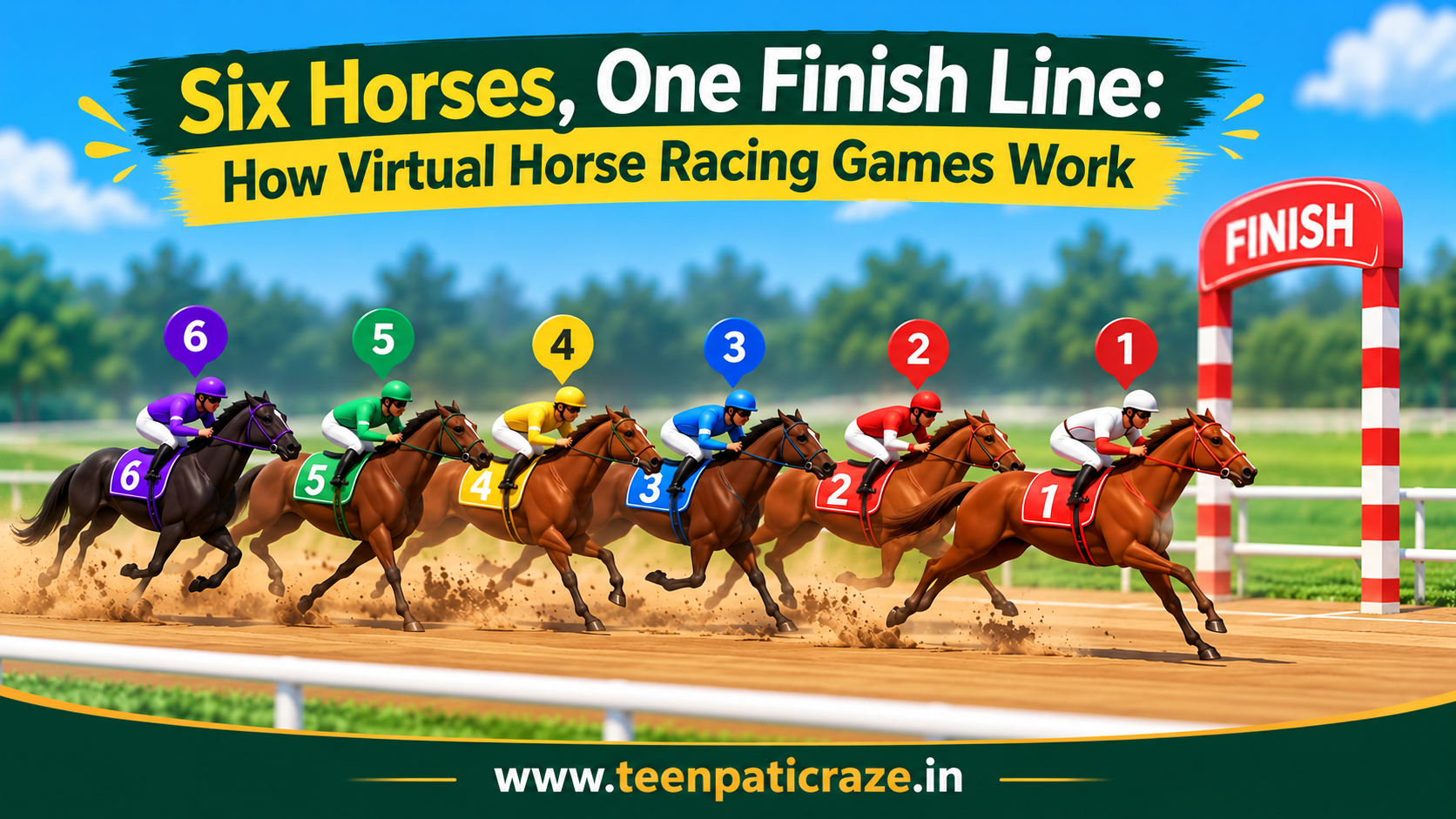
On a Horse betting game online, the result can come from a random number generator (RNG), which means previous race results do not determine what happens next. Teen Patti Craze describes its Horse Racing game as a software-driven virtual race with six runners, where each race works as an independent draw.
What Does “Due Horse” Mean?
A “due horse” is a common idea among players who believe a horse becomes more likely to win after losing several races.
For example, imagine Horse 4 loses five races in a row. A player may think:
“Horse 4 has lost five times, so it must be due to win now.”
That conclusion does not follow from an independent random process.
If the next race uses an RNG-based outcome, Horse 4 does not receive an automatic advantage because it lost the previous five races. The previous results belong to earlier rounds. They do not create a prediction for the next one.
Teen Patti Craze specifically explains that its Horse Racing outcomes use a certified-fair RNG and that each race works as an independent draw. The site also states that no horse is fixed to win across rounds.
How RNG Changes the “Due Horse” Idea
Each race starts with a fresh outcome
RNG stands for Random Number Generator. In a virtual game, software uses an RNG to generate an outcome according to the game's rules.
Regulated gambling standards provide a useful explanation of this concept. The UK Gambling Commission says RNG outputs should be acceptably random and unpredictable, with statistical testing used to assess randomness. Its standards also address virtual events and prohibit adaptive behaviour that changes probabilities during play.
This matters because a previous result should not act like a counter that says:
“Horse 4 has lost enough times. Give it a win.”
Randomness does not work that way.
A losing streak does not create a winning obligation
Suppose six horses appear in one race and Horse 2 finishes first. In the following race, Horse 2 may win again, lose, or finish somewhere else according to the game's outcome process.
Likewise, a horse that has not won recently does not automatically become the next winner.
The Responsible Gambling Council describes this as a common gambling misconception: previous outcomes do not make a future outcome “due.” It explains that independent outcomes do not become more favourable simply because earlier bets produced losses.
Why Players Notice Patterns
Human brains naturally look for patterns.
If you see:
-
Horse 1 wins
-
Horse 3 wins
-
Horse 1 wins
-
Horse 5 wins
-
Horse 3 wins
you may start searching for a sequence.
The same thing can happen after a long losing streak. A player may see five losses and expect a reversal.
The problem is that seeing a pattern does not prove that the pattern controls the next result. In an RNG-driven game, historical results can describe what happened, but they do not provide a guaranteed forecast of what will happen next.
That distinction is especially important in a fast game where several races can happen within a short session.
What Do Horse Racing Odds Actually Tell You?
Odds are useful information, but they do not turn a random outcome into a predictable one.
Teen Patti Craze displays separate odds for its six runners. The page explains that shorter-priced horses offer lower potential returns, while longer-priced runners offer higher potential returns but carry a lower stated chance within the game's odds structure.
This means players can compare the information shown on the board before confirming a selection.
However, odds should not be confused with certainty.
A horse with shorter odds can lose. A horse with longer odds can win. The displayed odds describe the game's pricing of the outcome; they do not guarantee the finishing order.
Can Previous Results Predict the Next Horse?
No reliable “due horse” system exists
Looking at previous races can help you understand your playing history, but it cannot create a guaranteed prediction system for an independent RNG outcome.
A simple example makes this easier to understand.
If Horse 6 loses eight consecutive races, it is tempting to think the ninth race should belong to Horse 6. But the number eight does not create a rule that forces a ninth-race win.
That is why strategies based on “waiting for a horse to become due” can give players a false sense of control.
What Should Beginners Focus On Instead?
Rather than searching for a hidden winning pattern, beginners can first learn how the game works.
Teen Patti Craze provides a practice mode where players can become familiar with the six-runner layout, race speed, odds and payout relationship without staking money. The site recommends understanding the board and setting a session budget and time limit before playing.
Players should also avoid increasing stakes simply because previous races went badly. A larger stake does not change an RNG result; it only increases the amount exposed to the next outcome.
For real-money play, the site restricts cash mode to adults aged 18 and above and advises players to stay within predefined money and time limits.
Final Takeaway
The “due horse” idea sounds logical because people naturally expect a losing streak to eventually correct itself. RNG-based games do not work on that assumption. Each race starts as a separate outcome, so a horse does not earn a hidden advantage because it lost the previous few rounds.
The practical approach is to understand the six-runner format, read the available odds, use practice mode to learn the interface, and avoid treating past results as a guaranteed prediction tool. Real-money play also carries financial risk, so players should set clear limits and never chase losses.
For users researching a horse race gambling apk or horse racing apps free download for android, the same principle remains important: downloading an app does not make past results predictive. Check the game's stated rules, understand how its RNG works, verify local laws and age requirements, and treat real-money gaming as entertainment rather than a source of income.
Frequently Asked Questions
Is a horse really “due” after several losses?
No. In the Horse Racing game described by Teen Patti Craze, each race is an independent RNG-driven outcome. A previous losing streak does not automatically make that horse more likely to win the next race.
Can I predict the next winner from previous results?
Previous results cannot provide a reliable prediction when each race operates independently. You can review historical results, but you should not treat a streak as a guaranteed signal for the next race.
Does increasing my stake improve my chances?
No. Increasing the amount you stake does not change the RNG outcome. It only increases the amount you could gain or lose from that particular selection.
Can I learn the game without using real money?
Yes. Teen Patti Craze says its Horse Racing game includes a practice mode, allowing users to learn the board, pace and odds without staking money.
